

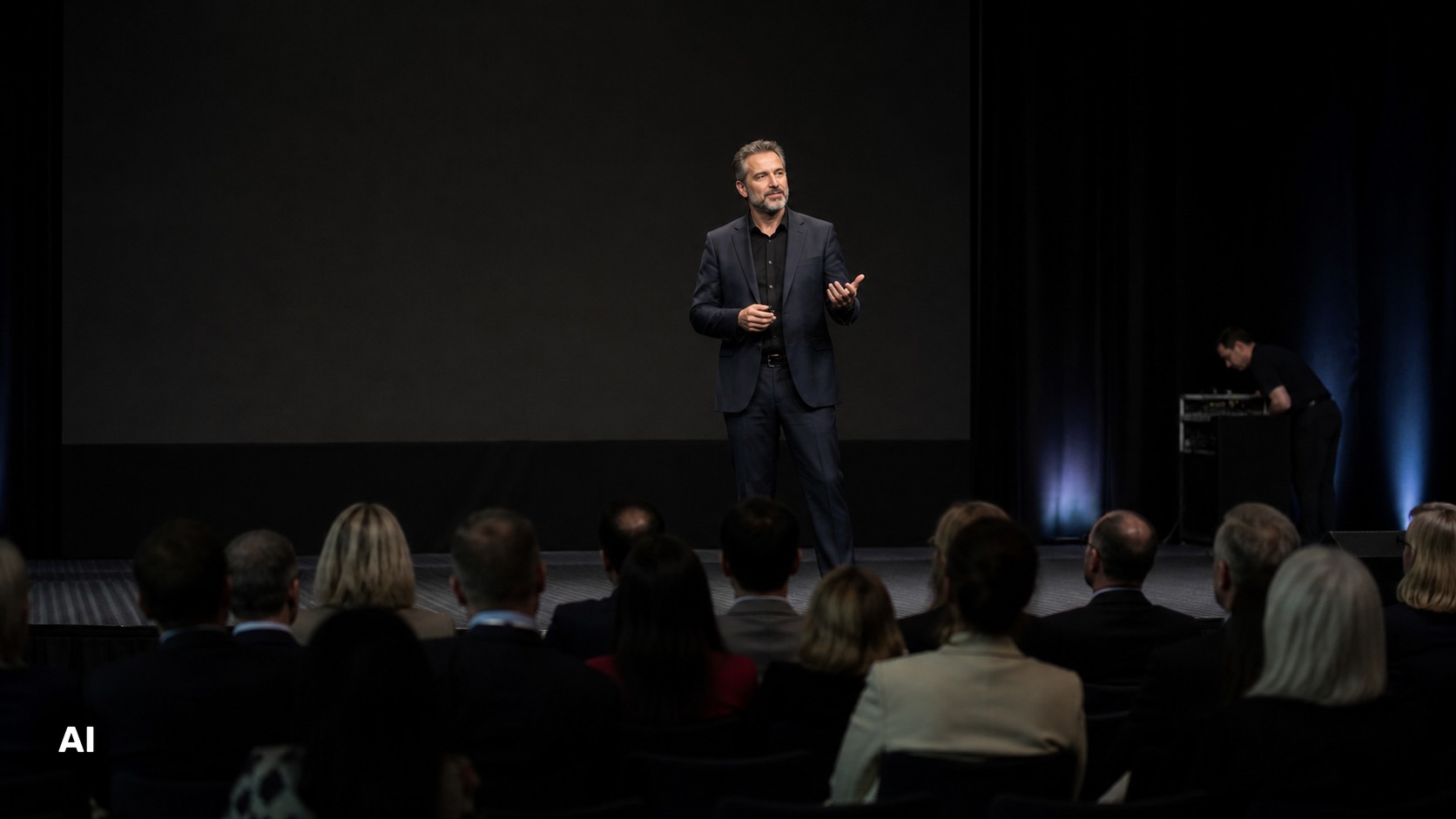
What Makes a Good Keynote Speaker?
Eight minutes into a strong keynote, the room feels different. Phones have disappeared, side conversations have stopped and even the sceptical delegates are following the idea on stage. Volume, humour and spectacular slides may help, but none of them explains that attention on its own. The audience can sense that this talk belongs to this occasion.
A good keynote speaker gives the audience and the event what they need at that particular moment. One room may need intellectual depth. Another may need confidence, orientation, productive discomfort or simply an intelligent form of entertainment. Quality lies in recognising the assignment and shaping the talk around it.
This creates a difficulty for event planners. The most valuable quality is only partly visible in a showreel. A video reveals how someone speaks. It says little about how well that person listens, how they handle a mixed audience or what they do when their planned sequence no longer suits the mood in the room. Judging a speaker starts well before the lights go down.
The first quality check happens in the briefing call
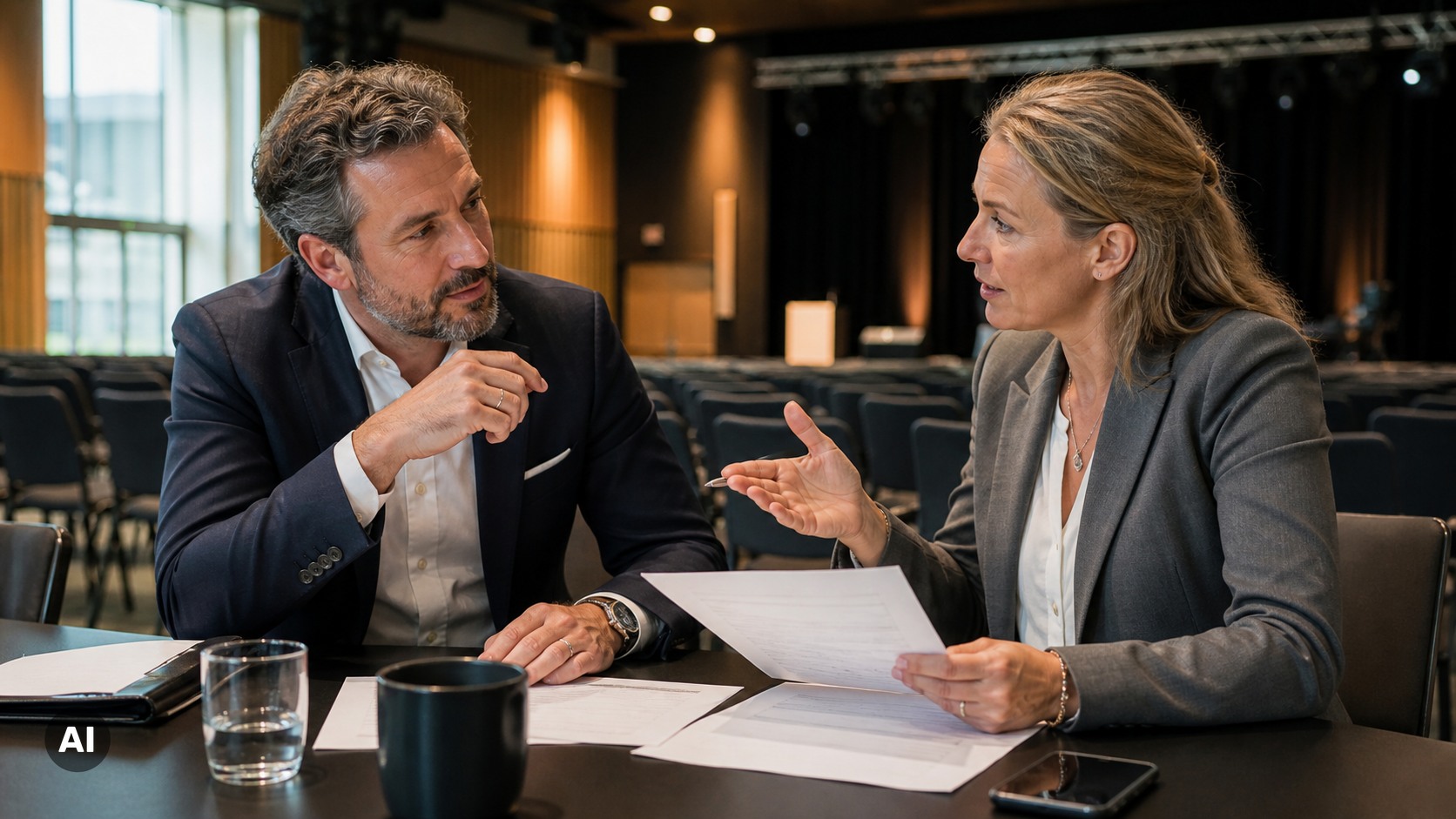
A proper conversation with the shortlisted speakers is not a courtesy added to the booking process. It is a sample of the work. The Events Industry Council's current international standards tell event professionals to identify speakers through selection criteria that serve the event's goals. They also call for expectations to reflect the organisation's culture and objectives.[1]
That makes the speaker's questions unusually revealing. A professional will want to know:
- Who will be in the room, and which professional roles will meet there?
- How wide is the range of prior knowledge?
- What does the audience currently think about the subject?
- Is the prevailing mood curious, sceptical, anxious, tired or openly resistant?
- What happens immediately before the keynote, and what follows it?
- Which idea should return later in the programme?
- Which uncomfortable issue is the speaker allowed to address?
- What would tell the planning team, two weeks later, that the keynote had done useful work?
Artificial intelligence is a good example of the problem. Some delegates may already be building their own applications. Others have tried ChatGPT once, while a few may reject the subject altogether. An hour of basic definitions loses the first group. Dense technical language leaves the second behind. A good speaker does not have to erase that knowledge gap, but the talk needs several points of entry so that both groups can follow the argument.
Industry research shows how practical this issue is. A report published in 2024 drew on responses from 340 event organisers and 378 experienced speakers. Among the organisers, 67 per cent named audience engagement as one of their main booking priorities. At the same time, 19 per cent said that speakers failing to understand who is in the audience was a pain point in the working relationship.[2] Audience fit is not a soft preference. It is part of managing the risk attached to a prominent programme slot.
Useful questions tell you more than easy promises
Be cautious when a speaker hears a few details and immediately declares that the existing talk is perfect. They may be right. They may also be planning to replace the company name on the title slide. Mentioning the city in the opening minute does not count as meaningful adaptation.
Real adaptation consists of choices. Which example should go? Which term needs an explanation? How far can the talk challenge the audience? Which story is wrong for this sector? Should the emphasis move from technical feasibility to leadership, employee participation or responsibility? Speakers with command of their subject can explain those choices. Someone who owns only a memorised sequence will tend to defend every slide.
TEDx gives its organisers comparable advice when developing a talk: look for structure, brevity and purpose. Each point should serve the main idea, make sense to the intended audience and explain why it matters.[3] A professional keynote is not the largest possible quantity of good material. It is a selection that holds together under a time limit.
Quality becomes visible in three stages
A booking decision is easier to defend when planners look beyond the minutes on stage. Preparation, performance and later response each reveal something different.
Positive signs and warning signs when choosing a speaker
No single detail proves quality. Several consistent signals, however, give planners a firmer basis for their decision.
| What to assess | Positive sign | Warning sign |
|---|---|---|
| Briefing call | The speaker asks about the objective, prior knowledge, audience attitude and programme context. | The conversation is dominated by biography, client names and fees. |
| Adaptation | The speaker can name the examples, terms or areas of emphasis they would change. | Personalisation means adding a company logo and the name of the city. |
| Subject command | The speaker answers follow-up questions, names limits and explains difficult material plainly. | Answers become vague as soon as the conversation leaves the rehearsed sequence. |
| Video | A longer, lightly edited excerpt reveals structure, pace and contact with the audience. | The showreel consists mainly of applause, music and rapid cuts. |
| References | Past clients describe the preparation, working relationship and audience response in concrete terms. | There are famous logos but no contact person or context. |
| Stage experience | The speaker can explain how they have handled changes, delays and interruptions. | Any departure from the running order is treated as the planner's problem. |
| Presence | Language, pauses, eye contact and movement serve the idea. | Energy replaces structure and effects disguise thin material. |
| Afterwards | The speaker asks what people should remember, discuss or do differently later. | Success is measured only in applause and photographs. |
Video proves stage ability, but not audience fit
Showreels are useful. They reveal voice, body language, pace and the scale of previous stages. They are weak as the sole basis for a decision. Two minutes of quick cuts prove that strong moments existed. They do not show whether the argument can carry forty-five or sixty minutes.
Ask for a longer excerpt from a real talk. It does not need expensive production. Watch the transitions between stories and arguments, the handling of quieter passages and whether the speaker notices the room instead of merely broadcasting at it. Listen for sentences clearly written for that audience. An excerpt containing a question or an unexpected reaction is especially informative.
References also become more useful when the question is specific. “Was the talk good?” almost always receives a polite answer. Ask how thorough the briefing was, what changes the speaker proposed, whether commitments were kept and what delegates discussed the following day.
On stage, professionalism looks like attention
With a very good keynote speaker, the audience often reaches a quick judgement: this person belongs on stage. That does not mean a particular pose or personality. Professionalism is the ability to remain attentive to the content, the audience and the situation at the same time.
A professional notices when an example has not landed. They can leave a pause alone instead of filling every quiet second. They recognise whether a tired conference audience needs energy or whether forced participation would only irritate people. If the talk is interrupted, they do not pretend nothing happened. They respond, wait until the room is ready and find their way back into the argument. Their presence creates confidence because their attention is not fixed on themselves.
Audience attention is a strong sign, but not a mechanical measure. Someone typing on a phone may be taking a note. A silent room may be absorbed or mentally elsewhere. Good speakers read several signals: eye contact, movement, well-timed laughter, the quality of later questions and what people talk about during the break.
Humour is optional. Attention is not.
Humour can open up difficult material. It releases tension, reduces distance and gives an audience breathing room after a dense passage. It remains a tool rather than a requirement. Some speakers draw people in with stories or an example nobody expected. Others make a clear argument and trust the room to stay with them, without reaching for a joke.
Research does not support a simple rule that more punchlines produce a better talk. In 2025, researchers reviewed five decades of work on humour in teaching. They found that jokes tied to the subject can help people pay attention and take part. The evidence for better learning is mixed, while unrelated humour may distract from the material.[4] The practical test for a keynote is straightforward: does the humour help the idea, or compete with it?
A talk may be extremely funny and still interchangeable. People remember the mood but not the argument. A serious keynote can stay with an audience for much longer if it makes a difficult subject intelligible and gives people a way to discuss it. Entertainment is one possible effect. It is not the definition of quality.
Experience gives a speaker room to recover
Stage experience is easy to underrate because it looks less exciting on a shortlist than a celebrated job title or a famous employer. Its value appears in the minutes that were never included in the production schedule. The microphone fails. The session begins twenty-five minutes late. The screen stays black. Another item is cancelled and the keynote suddenly needs to run longer. Something unexpected happens among the audience.
I recently watched a speaker deal with a man fainting during her keynote. She stopped at once, made sure that first aid was being organised and allowed the situation the space it required. Once the man was back on his feet and receiving care, she found a calm route into the talk again. Nobody can process such a moment as routine. Her response was professional precisely because people came before the programme, yet she did not lose the room.
Experience does not guarantee a good response. It does give a speaker a larger repertoire. Someone who has worked across many stages, room sizes, technical setups and audience reactions spends less attention on finding their own bearings. They can shorten a talk, skip a slide or cover five minutes without the screen while keeping the audience focused on the subject.
One credential worth checking is CSP, short for Certified Speaking Professional. The US-based National Speakers Association currently asks applicants for client evaluations and a video of a real talk. A reviewer scores that video, which must clear the required threshold before the application can continue.[5] For a planner, the useful part is the evidence behind the letters: past clients and recorded work both count. CSP still cannot show whether the speaker will suit a particular audience, and plenty of good speakers work without it. Treat the designation as supporting evidence, not as a requirement or a substitute for the briefing call.
Academic titles and famous names are often given too much weight
A professor may be an excellent keynote speaker. The title does not prove it. Academic qualifications say a great deal about someone's work in a field. They say far less about that person's ability to select, compress and explain material on a large stage while responding to several hundred people.
The same distinction applies to bestselling books, follower counts and prestigious employers. Those signals may have real value in marketing an event. A famous name can sell tickets, attract media attention or give sponsors greater visibility. In some cases, that may already fulfil an important part of the brief. Planners should simply avoid treating commercial drawing power and quality on stage as the same thing.
Substance can come from research. It can also come from years of practice, responsibility for difficult decisions or unusually careful observation. The test on stage is the connection between the two parts. Does the speaker have something of their own to say, and can they communicate it in a form this particular audience can use?
A speaker without deep command of the subject finds adaptation difficult because every change threatens the rehearsed surface. Someone who knows the material can swap examples, take an opposing view seriously and answer a question without rushing back to the next prepared punchline.
A good keynote continues after the applause
Applause records a response in the moment. It tells you that something happened in the room, but it cannot measure the full value of the talk. A keynote may receive a standing ovation and be forgotten the next morning. A quieter talk may reappear days later in a board meeting, a team discussion or a message to a client.
Planners can look for three kinds of later response:
- Memory: Which idea, story or phrase can delegates still name?
- Conversation: What returns during breaks, in internal channels or at later meetings?
- Use: Does someone ask a different question, reconsider a decision or try a next step?
Those forms of response should be discussed before the booking. Asking only whether people liked the keynote mostly measures sympathy and the mood of the day. Short questions at different times are more useful. Immediately after the talk, ask which idea remains. A few days later, find out whether it has appeared in another conversation. At an internal event, a follow-up after several weeks can test whether a question or working method introduced on stage is actually being used.
Response does not have to mean agreement. A good keynote speaker may create friction, challenge a comfortable assumption or press on a sensitive point. The provocation still needs a connection to the event's purpose. Shock without direction is attention spent badly.
The weakest talk often attracts little criticism. It simply disappears because nobody wants to spend more energy on it. A good keynote remains available to the audience, perhaps as a sentence, perhaps as a disagreement, and ideally as an idea that returns when the next decision has to be made.
The best booking question is: what should be different afterwards?
Before deciding on a speaker, subject or fee, the planning team should complete one sentence: “After this keynote, our audience should …” The answer may describe knowledge or emotion. People might need to place a technological development in context, find the confidence to take a difficult step, discuss a question they have been avoiding or share a moment of intelligent laughter.
That sentence makes videos, references and briefing calls easier to compare. One candidate may be brilliant in their field but wrong for the assignment. Another may bring less fame while understanding exactly what the room needs at that point in the programme. Choosing the latter is not settling for second best. It is good event planning.
If you are planning a keynote on artificial intelligence, my own briefing starts with the same questions. Who will be in the room? What feelings does the subject bring with it? Which idea should continue working after the applause?

Jan Ditgen
About the author
- 1,000+talks
- CSPCertified Speaking Professional
- 4keynote languages
Jan Ditgen is a keynote speaker on artificial intelligence. He has delivered more than 1,000 talks and holds the Certified Speaking Professional (CSP) designation from the National Speakers Association, the highest international designation for professional speakers.
He did not begin his career in computer science, which helps him explain artificial intelligence to audiences without a technical background in a clear, practical and engaging way. He speaks at companies, associations and professional conferences in German, English, Spanish and French. His keynotes examine the practical use of AI at work, its opportunities and risks, and how people can preserve their own judgment when answers are always available.
Jan Ditgen has written several specialist books. His books and articles give him room to examine questions about AI that a 60-minute keynote can only touch on. He connects his experience with AI and the events industry with clear analysis for companies and event organizers. Jan Ditgen is available to book as an AI keynote speaker on artificial intelligence.
Sources
- Events Industry Council: CMP International Standards 2025, event design and speaker selection
- Professional Convention Management Association: Survey Explores Speaker and Planner Dynamics
- TED: TEDx Organizer Guide, Outline and Script
- Zhou and Lee: Teaching and learning with instructional humor, a 2025 review in Frontiers in Psychology
- National Speakers Association: How to Earn Your Certified Speaking Professional Designation, 2026 guide
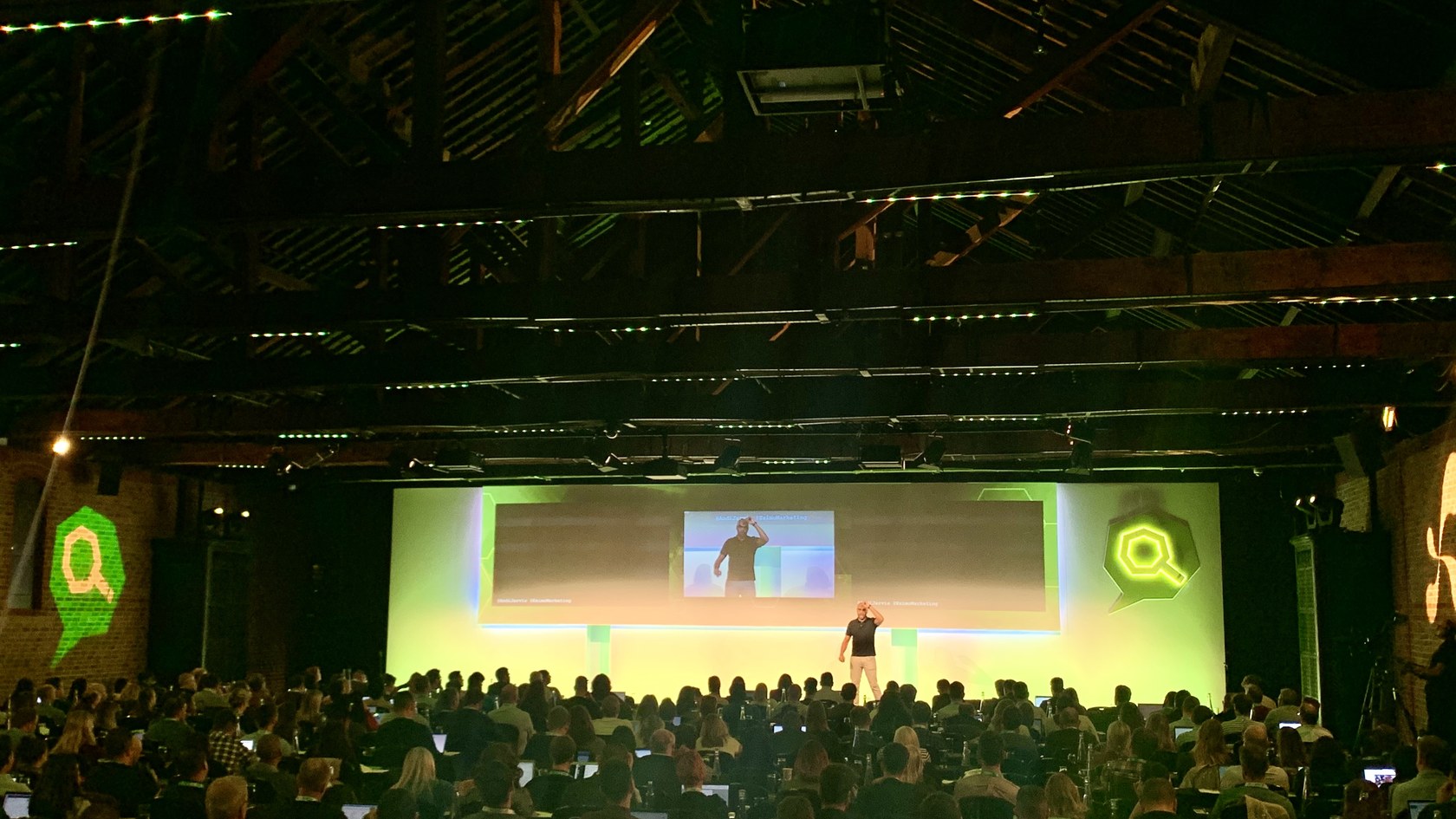
- Delegate Connect Images: Speaker in front of a large audience at the SearchLove conference in London. License: CC BY 2.0. Edit: cropped to the shared article format.
Contact
Phone: +49 221 80 14 96 0
AI keynote speaker Jan Ditgen
EWK Vortrags GmbH & Co. KG
Gartenstr. 6
50996 Cologne, Germany
Last updated: 13 August 2026
Contact

Gartenstr. 6
50996 Cologne
Germany
Phone: +49 221 - 80 14 96 11
Fax: 0221 - 80 14 96 29
E-Mail: ki@ewk-institut.eu