

What Is a Keynote Speaker? Definition, Purpose and Role at Events
The agenda says “10:00: Keynote”. A technical session follows at eleven. Yet the planning team may still struggle to explain what made the first talk a keynote. Was it the large stage, the well-known name or the highest fee on the speaker budget? None of those details defines the format.
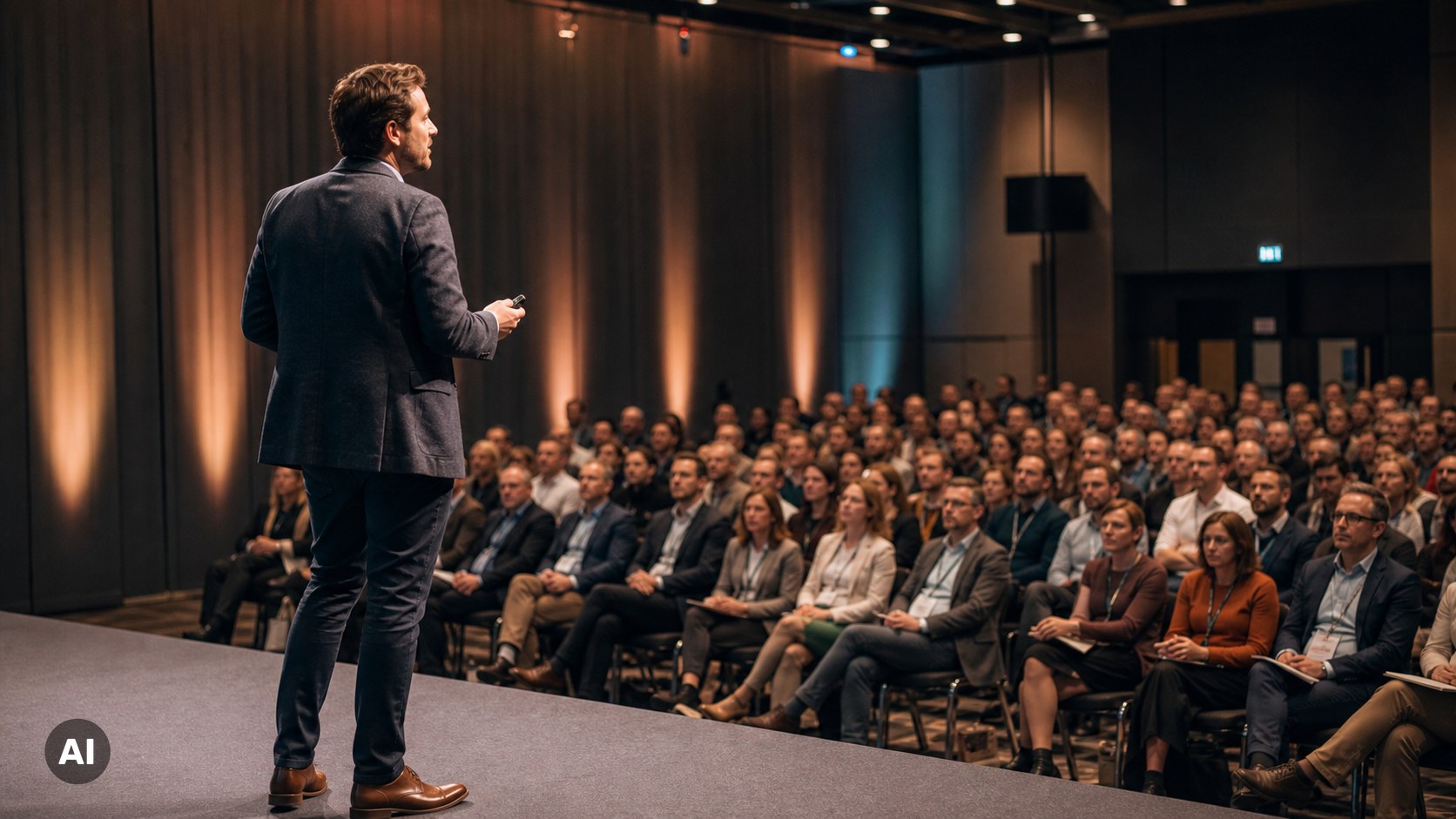
A keynote speaker gives the leading address of an event. The talk frames the main subject, explains why it matters to the people in the room and gives the rest of the programme a point of reference. A keynote does not need to carry the greatest possible volume of information. Its job is to focus attention and make one important idea easier to see.
A short definition: the keynote sets the intellectual tone
The Cambridge Business English Dictionary[1] defines a keynote address as the most important speech at a large meeting. Merriam-Webster[2] adds that it presents the issues of primary interest to an assembly and may build unity and enthusiasm. Read together, the definitions describe more than a prominent slot in the timetable. The speech has to clarify the subject while giving the audience a reason to care about it.
Consider two speakers on the same programme. A renowned specialist is scheduled for a technical breakout; a less familiar name opens on the main stage and poses the question that follows delegates through the day. The second speaker has the keynote assignment. Fame may help to market the event, but the job given to each speech decides its place in the programme.
The term began in music, long before the conference industry
In music, the keynote was the fundamental note of a key, the reference from which the other notes took their place. The word later acquired a figurative meaning: a leading idea or principle. Merriam-Webster dates the first known use of “keynote address” to 1863[2]. The phrase predates conference centres, slide software and the professional speaker market by many decades.
The musical image remains useful. A keynote does not have to preview every session. It makes the programme's governing idea audible. At a leadership conference, that idea might concern responsibility under uncertainty. At a sales meeting, it could be trust in increasingly automated customer communication. Workshops and panel discussions can then return to the frame established on the main stage.
The speaker creates meaning rather than adding to the information pile
Most conferences already contain more data, slides and specialist knowledge than an audience can absorb in one day. A keynote cannot solve that problem by compressing even more material into forty-five minutes. It has to choose. What does this audience need to understand before the subject becomes relevant to their work? Which connection is easily missed? What consequence will people recognise once they are back at their desks?
A keynote speaker will usually perform several of the following tasks:
- Place the main subject in a wider business, social or professional context.
- Direct attention towards one governing question rather than treating every subtopic equally.
- Use examples and stories to connect separate facts into a picture the audience can follow.
- Give participants language and ideas they can carry into later sessions and conversations.
The ideal response is often an “I hadn't seen it that way” moment. Statistics and models may support that moment, but they rarely produce it on their own. A familiar example viewed from a new angle can do more. The story does not replace the argument. It gives the audience a route into it.
Four factors that shape an effective keynote
A keynote is not created by the subject alone. Intended outcome, audience, central tone and continuity shape the speech and what remains in the room afterwards.
Keynote, specialist talk or workshop?
The programme function should determine the format, not the label used in the running order.
| Format | Primary purpose | Audience role | Typical programme position |
|---|---|---|---|
| Keynote | Orientation and a shared frame | Listen, think and respond | Opening, plenary or closing |
| Specialist talk | Explain a subject in depth | Follow the argument and ask questions | Conference track or expert session |
| Impulse talk | Set up one idea for discussion | Take in a short stimulus | Before a panel, workshop or debate |
| Workshop | Apply a method or produce an outcome | Work actively and test ideas | Smaller working session |
| Moderation | Guide the programme and its transitions | Follow the sequence and participate | Across the event |
Substance and emotion have to support the same idea
A keynote is allowed to entertain and energise. A lively performance without substance, however, leaves the event with little beyond a pleasant memory. The opposite problem is just as common. A presentation can be accurate and well researched while giving the audience no reason to care about its implications.
Emotion does not require theatrical language or a dramatic call to action. Curiosity, relief, confidence and productive discomfort all count. An artificial intelligence keynote may give managers permission to say no to a poorly chosen application. A leadership talk may reveal that an apparent control problem began with an unclear brief. The feeling works when it grows out of a credible observation.
Opening and closing keynotes need different designs
Keynotes frequently open an event, but the format is not tied to the first slot. Placement changes the assignment:
- An opening keynote introduces the subject, establishes its significance and gives the audience a question through which to view the sessions that follow.
- A closing keynote gathers selected ideas without retelling the entire event. It sets a final emphasis and leaves the audience with a direction for the next conversation or working day.
A keynote in the middle of the programme can also work well. After several parallel sessions, it brings participants back into one room and resets their attention. “Keynote at 2 p.m.” is therefore an incomplete brief. The speaker needs to know what has happened before the talk, what follows it and how the audience is likely to feel by that point in the day.
A keynote is not a workshop with fewer chairs
The most common format confusion involves workshops. A keynote normally addresses the whole audience. Participants listen, think and respond, but they do not spend a substantial part of the session working on their own cases. A workshop gives participants a different responsibility. The facilitator introduces a method, sets a task, observes the work and helps when people get stuck. By the end, something has been tried, discussed or produced.
Other event formats have their own jobs:
- A keynote frames the shared subject for the main audience.
- A technical or specialist presentation examines a defined subject in greater depth for people who need that knowledge.
- An impulse talk is usually shorter and is designed to start a discussion or redirect attention.
- A workshop gives participants time to apply a method, work through a question or develop an output.
- An emcee or moderator connects speakers, interviews and organisational information across the programme.
The boundaries can be flexible. A keynote may include a brief audience poll, questions or a short reflective exercise. Those elements do not turn it into a workshop. A workshop may begin with a strong twenty-minute presentation without becoming a keynote. Event planners need to decide how much of the session belongs to the speaker and how much belongs to the audience's own work.
“Keynote speaker” does not mean exactly the same thing in every market
In conventional English usage, the keynote is the principal address of an event. The German-speaking event market often uses “Keynote Speaker” as a broader label for professional conference speakers. The Duden dictionary[3], for example, describes a Keynote-Speaker as someone who gives an impulse talk. That definition covers a wider set of appearances than Cambridge's “most important speech” at a large meeting[1].
International agencies acknowledge similar overlap. AAE Speakers Bureau[4] notes that keynote speakers, public speakers, motivational speakers and professional speakers are often treated as interchangeable categories, even though their emphasis may differ. Even so, its description gives the keynote a specific job: establishing the event's theme and main message.
This variation is not a reason to correct every client who uses the term loosely. One organiser may ask for a “keynote” and expect a sharp twenty-five-minute opener at a customer event. At another event, the same word may refer to a sixty-minute closing address rich in technical detail. Both requests make sense. Trouble begins when the organiser and the speaker use the same label for different assignments.
When does an event benefit from a keynote?
A keynote earns its place when the programme needs a shared perspective across individual sessions. It can connect people who will later separate into workshops, panels or specialist tracks. The format is particularly useful when the subject is new to part of the audience, open to disagreement or difficult to relate to everyday work.
Some situations call for that shared perspective more clearly than others:
- At a strategy meeting, leaders need a shared reading of the situation before making decisions.
- At a conference, one question can connect otherwise separate specialist sessions.
- A customer event can explain a market or technology issue without sliding into a product pitch.
- An annual meeting can place the previous year in context and point towards the next period of work.
- During an internal change event, the facts may be familiar while their practical meaning remains unsettled.
A keynote may add little to a very short meeting, a working session or an event devoted entirely to practising one defined skill. A two-hour spreadsheet workshop does not improve simply because its first thirty minutes are renamed as a keynote. The money may be better spent on smaller groups, extra practice time or stronger learning materials.
Start with the intended effect before drawing up a speaker shortlist
Advice from the events industry places the audience and the assignment ahead of instinct. Meeting Professionals International recommends writing down what the session and the wider meeting are meant to achieve before assessing speakers. Reference checks should cover listening, audience knowledge and adaptation, rather than stage presence alone. In its guidance on choosing an event speaker[5], MPI identifies poor customisation as a recurring source of criticism in speaker evaluations.
A 2024 industry survey discussed by PCMA[6] reached 340 event organisers. Sixty-seven per cent named audience engagement as a booking priority and 49 per cent named audience education. Nineteen per cent reported a recurring problem: speakers did not understand who was in the room. The figures help explain why a famous name with a generic presentation can be an expensive mismatch.
Seven questions turn an enquiry into a useful brief
Date, venue and audience size are not enough for a speaker to select the right argument, examples and tone. Organisers should answer these questions before booking:
- What job does the talk have in the programme? It might open the event, restore attention after a break or close the day.
- What should the audience see differently afterwards? Name a specific shift in understanding instead of asking the speaker to “be inspiring”.
- Who will be in the room? Their roles, prior knowledge, proximity to the issue and likely concerns all affect the talk.
- What will have happened before the keynote? Earlier sessions, internal announcements and difficult company news can alter how a message is heard.
- Which message cannot be lost? One or two priorities give the talk a firmer basis than a long list of requested points.
- How much adaptation is expected? Industry examples, internal language and organisation-specific cases should be agreed before the contract is signed.
- What is outside the brief? Confidential matters, political sensitivities and unwanted product promotion need explicit boundaries.
Those answers also create a better way to assess showreels and proposals. The organiser can judge whether the argument fits the assignment, whether the examples will make sense to this audience and whether the speaker gives performance and content the right relative weight.
Four assumptions often lead to the wrong booking
“The best-known person will give the best keynote.” Recognition can attract registrations and press attention. It does not guarantee useful content or a close fit with the event's subject. A celebrity may be the right choice for one programme. A lesser-known specialist may serve another audience far better.
“A keynote has to motivate people.” Motivation can be a valid effect, but it needs an object. What should people feel ready to examine, discuss or change, and what gives them a credible reason? Energy without a clear direction often disappears before the audience has left the venue.
“More practical tips make a better keynote.” Useful suggestions have a place in a keynote, but a list of twenty techniques can turn the talk into a rushed training session. One well-developed idea, supported by a few strong examples, is often easier to remember and discuss.
“An event can have only one keynote.” Historically, the term points towards one defining address. Current programmes nevertheless advertise opening keynotes, closing keynotes and several featured main-stage talks. The terminology does no harm if each talk has an intelligible role. If every presentation is called a keynote, the label stops helping the planning team.
The right speaker is the person who fits the assignment
A booking process works better when it begins with a sentence rather than a list of famous names: “After this talk, our audience should understand that …” Subject knowledge, style, stage experience and fee can then be assessed against an actual job. A good introductory call also reveals whether the speaker listens, asks useful questions and takes the surrounding programme seriously.
On the day, that preparation should be almost invisible. The talk belongs in the room without sounding like an extended corporate presentation. People carry an idea into the coffee break, use it in the following session and mention it again when they return to work. That is what it means for a keynote to set the tone.
If you are planning an artificial intelligence keynote, I begin with the same questions: What must the talk do within the programme? Who will be in the room? Which idea should continue working after the audience leaves? The answers shape a talk for the occasion instead of filling an empty slot in the agenda.

Jan Ditgen
About the author
- 1,000+talks
- CSPCertified Speaking Professional
- 4keynote languages
Jan Ditgen is a keynote speaker on artificial intelligence. He has delivered more than 1,000 talks and holds the Certified Speaking Professional (CSP) designation from the National Speakers Association, the highest international designation for professional speakers.
He did not begin his career in computer science, which helps him explain artificial intelligence to audiences without a technical background in a clear, practical and engaging way. He speaks at companies, associations and professional conferences in German, English, Spanish and French. His keynotes examine the practical use of AI at work, its opportunities and risks, and how people can preserve their own judgment when answers are always available.
Jan Ditgen has written several specialist books. His books and articles give him room to examine questions about AI that a 60-minute keynote can only touch on. He connects his experience with AI and the events industry with clear analysis for companies and event organizers. Jan Ditgen is available to book as an AI keynote speaker on artificial intelligence.
Sources and further reading
- Cambridge Dictionary: Definition of “keynote address”
- Merriam-Webster: Meaning and word history of “keynote address”
- Duden: German meaning and spelling of “Keynote-Speaker”
- AAE Speakers Bureau: Defining and booking a keynote speaker
- Meeting Professionals International: How to choose an event speaker
- PCMA: Findings from the 2024 Speaking Industry Benchmark Report
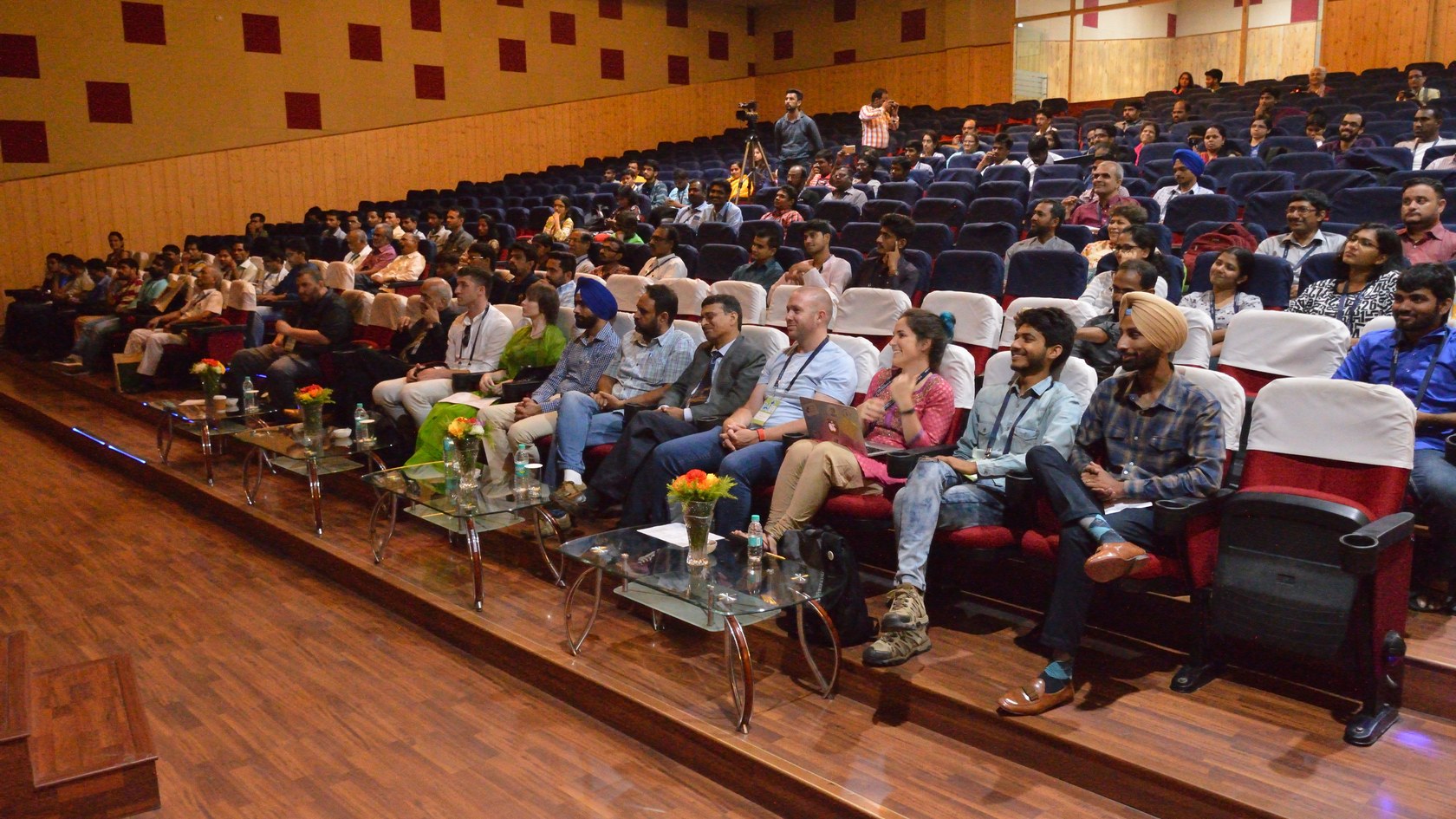
- Biswarup Ganguly: Audience during a keynote at WikiConference India 2016 (Wikimedia Commons). License: CC BY 3.0. Edit: cropped to the shared article format.
Contact
Phone: +49 221 80 14 96 0
AI keynote speaker Jan Ditgen
EWK Vortrags GmbH & Co. KG
Gartenstr. 6
50996 Cologne, Germany
Last updated: 13 August 2026
Contact

Gartenstr. 6
50996 Cologne
Germany
Phone: +49 221 - 80 14 96 11
Fax: 0221 - 80 14 96 29
E-Mail: ki@ewk-institut.eu